The Reality Check: What You Really Get
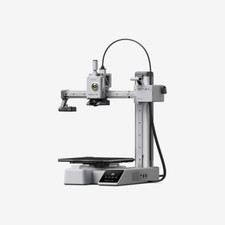
The A1 Mini is Bambu's attempt to deliver a truly compact entry-level printer. With a build volume of 160 × 160 × 160 mm, it's tiny compared to its larger siblings, the A1, P1S, and X1C. This means: miniature models and small replacement parts are doable, but for larger projects, you'll need to break them down into smaller pieces.
The maximum nozzle temperature of 300°C sounds promising and is theoretically sufficient for more demanding materials. However, the bed temperature is limited to a meager 80°C, while other Bambu printers can reach at least 100°C. This becomes problematic with PETG, as it often doesn't adhere properly at 80°C and can warp when cooling down.
Even more critical is the lack of enclosure. The A1 Mini is completely open, has no chamber heating, and comes without a hardened nozzle. This severely limits your material options: you can forget about ABS due to warping, and abrasive filaments like carbon-reinforced materials will wear out the standard nozzle quickly.
Materials: Here You Hit Limits
Bambu markets the A1 Mini for PLA and PETG—and for good reason. PLA prints without issues, even at the low bed temperatures. With PETG, things get tricky: the 80°C bed temperature is borderline, especially with larger print areas. You'll struggle more with warping than with printers that have a 100°C heated bed.
Forget about ABS, ASA, or other technical materials that require a closed chamber. Without enclosure and with only 80°C bed temperature, it's just a waste of time. Abrasive filaments like PLA-CF are also problematic because the standard nozzle wears out quickly, and Bambu doesn't provide a hardened nozzle as standard.
So, the material selection is significantly more limited than with the pricier models. If you're mainly printing PLA prototypes and occasionally PETG, it's fine. But if you want to take full advantage of modern filaments, you’d be better off with the P1S or X1C.
Performance: Surprisingly Solid for the Size
Despite the limitations, the A1 Mini prints decently. The print quality with PLA is respectable, even if it doesn't reach the precision of the larger CoreXY machines. The compact design has its advantages too: less moving mass means potentially fewer vibrations with small print objects.
The biggest issue is the tiny build volume. 160 mm in every direction is too small for many standard benchmarks. You can still print a 3DBenchy easily, but with a regular smartphone case, it gets tight. You'll constantly need to scale or split models.
Upgrade Potential: What Works, What Doesn't
The A1 Mini can be upgraded, but physics sets limits. You can retrofit a hardened nozzle, which solves the abrasion problem. The BIQU Panda Claw Upgrade with RNC nano-coated hardened steel gears is interesting, as it significantly improves extruder durability with challenging materials.
For the print surfaces, you have the full Bambu range: Cool Plate SuperTack, Smooth PEI, Textured PEI, and 3D Effect Plate are all compatible. This helps with the adhesion of various materials.
What you can't change: the build volume remains tiny, retrofitting an enclosure is practically impossible, and the 80°C bed temperature is hardware-limited. These boundaries are set in stone.
When the A1 Mini Makes Sense
The A1 Mini isn't a bad printer, but it has a very specific target audience. It works if you really have limited space, mainly print small PLA parts, and are looking for an affordable entry into the Bambu ecosystem. It can fit well for schools, offices, or as a secondary printer for small parts.
It becomes problematic when you need growth potential. The tiny build volume and material restrictions can quickly become frustrating as your projects grow larger or more demanding. Then you'll regret not opting for the A1 or P1S right away.
The Hard Facts for Your Purchase Decision
The A1 Mini is a compromise printer for very specific use cases. If space is your main issue and you only print PLA, it can work. In all other cases, it's a dead end. The extra cost for the regular A1 with its significantly larger build volume and 100°C heated bed is usually better invested. And if you seriously want to dive into technical materials, there's no way around the enclosed P1S.
The A1 Mini is honest: it does exactly what it was built for, but not a millimeter more. The question is whether that's enough for your projects.