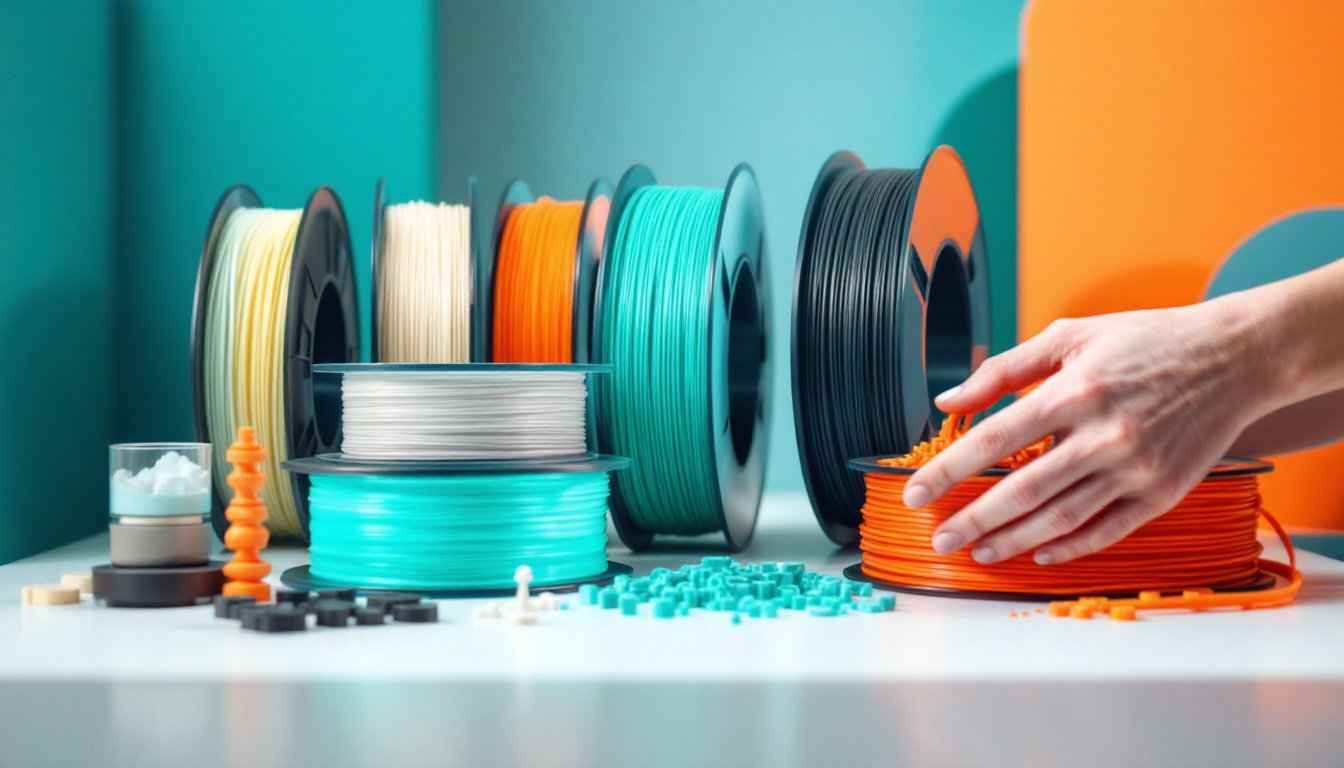
If you regularly find yourself in front of your 3D printer, you know the scenario: You've meticulously calibrated everything, leveled the bed, and yet the print looks like an accident. Often, the issue isn't with the mechanics at all, but with the spool sitting on top of the holder. Whether it's PLA, ABS, PETG, or technical plastics – each material has its own ignition fuse. If you don't know the quirks, you'll spend days troubleshooting, battling clogged hotends, or tearing the expensive PEI coating off the print bed when trying to remove your print.
The Material Profiles in Detail
PLA is the absolute standard for anything that won't be mechanically stressed or left in a hot car during summer. It practically prints itself, adheres well, but is extremely brittle in its final state. If you need tougher functional parts, you often turn to PETG. The sweet spot for clean layer adhesion and a stable flow usually lies between 235°C and 245°C in practice – if you print PETG at the often recommended 220°C from old forums, you risk brittle components because the layers simply don't fuse properly. Set your heated bed to about 70°C accordingly.
ABS plays in a whole different league. It offers massive temperature and impact resistance and typically prints at 240-260°C, but it shrinks significantly when cooling. Without a closed, ideally preheated enclosure, you'll have no chance of achieving dimensionally accurate parts due to extreme warping. If you venture into abrasive materials like carbon (CF), fiberglass, or glow-in-the-dark, it becomes mechanically demanding. Contrary to some myths, you definitely don't need a complete steel extruder housing for this. The only things you absolutely must replace are the nozzle and the drive gears in the extruder with hardened steel variants. A standard brass nozzle will be completely worn down after half a spool of carbon filament, ruining your flow.
The Guaranteed Pitfalls and Real Fixes
The absolute nemesis in everyday printing is moisture. Filament absorbs water from the air, with technical materials like nylon (PA), TPU, and polycarbonate (PC) being true sponges that sizzle and pop in the hotend while printing because the water boils in the nozzle. PLA is also hygroscopic, but it pops less often – you can tell the filament is moist when the strand breaks brittle in the Bowden tube before you even start printing. The only reliable fix is an active filament dryer, where the spool is baked at the correct values before printing.
Another massive problem is bed adhesion, especially when switching to PETG. A clean print bed is important, but there's a dangerous pitfall here: If you perfectly degrease a smooth PEI plate or glass bed with isopropanol and then print PETG directly on it, the material will fuse irreversibly with the surface as it cools. You'll literally tear hand-sized chunks out of the print bed when trying to remove it. A release agent like a simple glue stick, 3DLac, or special Magigoo is absolutely essential to protect the print bed.
To combat the notorious stringing with PETG, clean retract values and adjusted travel speeds help. As a solid starting point, 5 mm retraction for a classic Bowden setup and 1 to 2 mm for a direct-drive extruder have proven effective.
Which Material for Which Project
If you're diving into 3D printing or need quick, visually appealing prototypes without high heat resistance demands, stick with PLA. It forgives mistakes in settings and doesn't require hardware mods. For mechanical parts in everyday use, mounts, or enclosures, PETG is the first choice, as long as you keep the temperatures in the upper range and consistently protect your print bed with a release agent.
Save ABS or ASA for functional parts that really need to withstand heat or weather, or that you want to smooth with acetone afterward – provided your printer has an enclosure. Exotic filaments with fiber content are fantastic for extremely stiff, technical constructions, but they demand a no-compromise upgrade of your nozzle-adjacent hardware. If you skimp on the wrong end here, you'll be searching for the error in the wrong place for days.