The Secret Weapons of Lightweight Projects
Foaming PLA and TPU are the materials you need for lightweight projects if you're ready to understand the physics behind them and radically adjust your slicer settings. These active foaming materials expand during printing in the nozzle and can significantly save weight – but only if you know what you're doing.
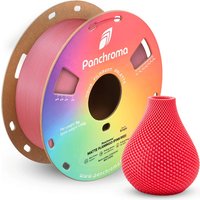
With foaming PLA like Bambu PLA Aero or ColorFabb LW-PLA, blowing agents in the filament react to heat and create tiny gas bubbles. This makes the material porous and lighter. Foaming TPU like Siraya TPU Air or ColorFabb varioShore combines this weight reduction with the flexibility of TPU – you can control the Shore hardness through the printing temperature.
The trick: Higher temperatures mean more foaming, less density, but also less strength. With Siraya TPU Air, the Shore hardness varies between 78A at 230°C and 63A at 270°C. This gives you room for customized properties.
The Settings That Work
Foaming materials break all standard printing rules. The most important parameter is the nozzle temperature: Bambu PLA Aero prints at 245°C, while Siraya TPU Air operates between 230-270°C. The first layer should be 10°C hotter than the rest of the layers.
Drastically reduce flow: Set the flow to 0.6 instead of the usual 1.0. The material expands in the nozzle, and too much flow leads to over-extruded, misshapen layers. For foaming TPU, this value is even more critical – the material can expand up to twice its size.
Turn retraction completely off: Set retraction distance and speed to 0. Foaming materials ooze continuously because the expansion in the hot nozzle doesn't stop. Any attempt at retraction only worsens the problem. Instead, design your models to minimize travel moves.
The print speed needs to be reduced to 30-60mm/s. Foaming needs time – the chemical reaction doesn’t happen during high-speed prints. Siraya even recommends only 30mm/s for optimal results.
Fan speed is counterintuitive: Siraya TPU Air wants 100% fan to quickly fix the foamed structure. Bambu PLA Aero, on the other hand, only needs 30% or less. This is due to the different foaming chemistries.
The Pitfalls
Moisture completely kills foaming TPU. The material is hygroscopic and absorbs water like a sponge. Moist filament foams unevenly, strings like crazy, and the layers don’t stick. Dry Siraya TPU Air at 70-80°C for 4-6 hours before printing and print directly from the dry box.
AMS and Bowden systems are problematic. Foaming TPU is often too soft for automatic filament changers. The material can kink in the tubes and clog. Even Polymaker warns against using TPU in the AMS. Use the rear spool holder for manual feed.
Travel lines are the death knell. Any movement without extrusion leaves ooze traces because the material continues to foam in the nozzle. Design your models as closed loops or use the spiral vase mode. Bambu Studio offers special RC model profiles that do just that.
Bed adhesion becomes a nightmare. Foaming materials stick extremely well to the print bed. On PEI surfaces, you need release agents like PVP glue stick or Magigoo. Otherwise, you’ll tear pieces out of the bed when removing prints.
Material Comparison
Standard TPU vs. Foaming TPU: Fillamentum TPU 92A achieves 49 MPa tensile strength at 1.20 g/cm³ density. Siraya TPU Air only reaches 10.3 MPa at 240°C but weighs only 0.88 g/cm³ – 27% lighter. At 270°C, it’s even just 0.51 g/cm³, but the strength drops to 3.8 MPa.
Shore hardness comparison: Classic TPUs have fixed values – TPU90 stays at 90A, TPU95 at 95A. Foaming TPU is variable: ColorFabb varioShore can be adjusted between soft and firm, while Siraya TPU Air ranges from 63A to 78A depending on temperature.
Printability: TPU95-HF runs on any printer, TPU90 requires direct drive, and TPU95 can work on Bowden at very slow speeds if necessary. Foaming TPU is even pickier – direct drive is a must, AMS is off-limits.
Storage and Care
Moisture protection is vital for foaming TPU. Fillamentum TPU has "high moisture sensitivity" – that's an understatement. Siraya TPU Air must go into the dry box with active desiccants immediately after opening. Goal: below 15% humidity.
Drying: 70-80°C for 4-6 hours in a filament dryer. Not in a regular oven – the temperature distribution is too uneven. For print times over 4 hours, print directly from the dry box.
Long-term storage: Back in the original bag with desiccant, seal airtight. Foaming additives can react prematurely if stored incorrectly, rendering the filament unusable.
Foaming PLA is less finicky, but the same rule applies: store dry and protect from temperature fluctuations. The blowing agents are temperature-sensitive and can lose their effectiveness if not stored properly.