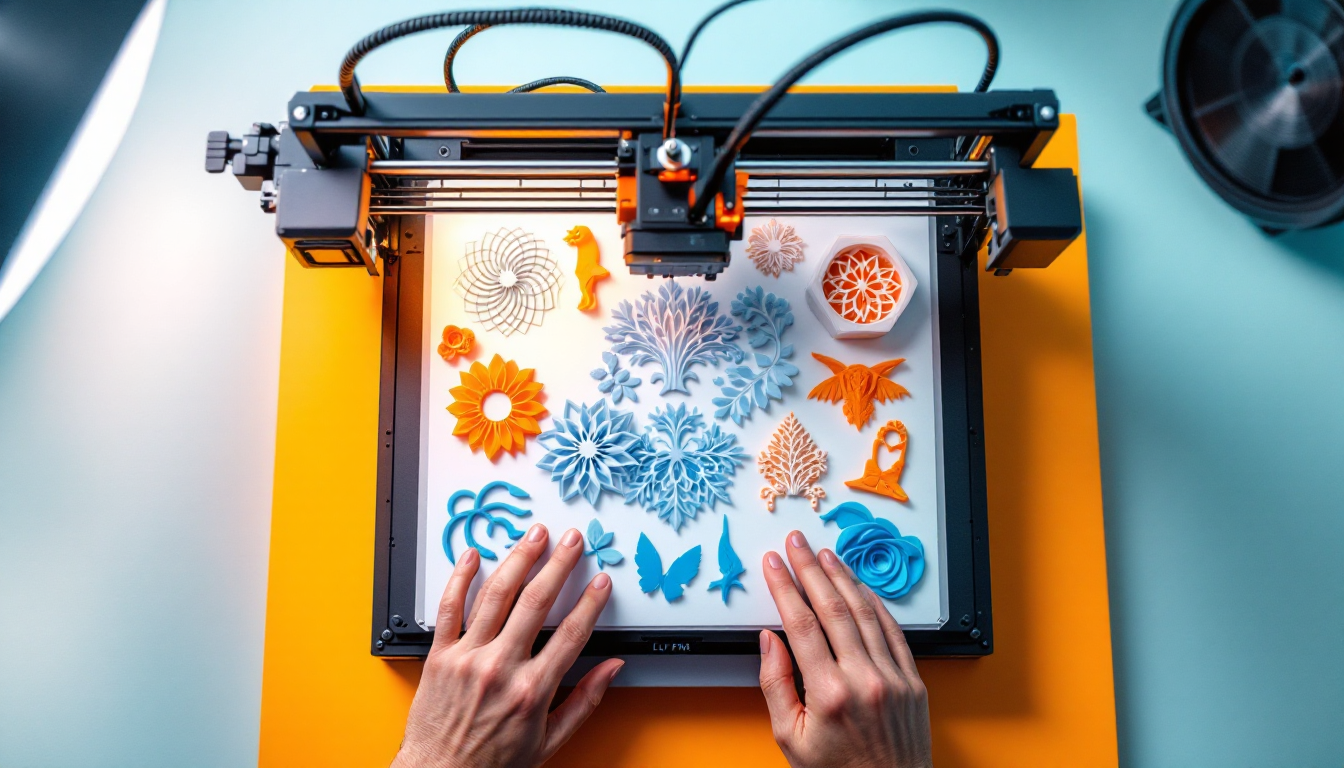
Flexible materials for large-format 3D printing are a real challenge. TPU and other elastomers can quickly push you to your limits when printing large objects if you don't know what to pay attention to. The Shore hardness of 60A to 90A is crucial for your chances of success — the softer the material, the more difficult the printing process becomes.
In large-format prints, all typical TPU issues are drastically amplified. What works for small parts is guaranteed to lead to disaster with a 300x300 mm footprint. Material costs are high, print times are endless, and a failure after 20 hours really hurts.
The Settings That Work
The nozzle temperature for flexible materials ranges between 230 and 245°C, depending on the Shore hardness and the manufacturer. For large-format prints, you should increase the temperature by another 5°C to reduce material resistance. It sounds counterproductive, but it actually lowers the risk of clogging during long print paths.
The bed temperature should be set between 60 and 75°C. Here’s the rule: the larger the object, the higher the bed temperature. For a 400x400 mm print, you need the full 75°C; otherwise, the corners will definitely lift. The powder-coated spring steel sheet is your best friend — smooth PEI surfaces are a sure path to disaster for large TPU prints.
Print speed is the key point: 20 mm/s is typical, and you can dare to go up to a maximum of 30 to 40 mm/s. For large objects, it's better to stick to 15 mm/s for the outer walls. Yes, that means print times of 30+ hours for large parts, but speed here only leads to clogged nozzles and tangled filament in the extruder gears.
Keep the print cooling completely off. No part cooling, no exceptions. TPU hates cold air and becomes even harder to process with cooling.
The Pitfalls
The biggest killer for large-format TPU prints is extruder tension. The tension screw must be set so loosely that the gears just gently push the filament through. Too much pressure, and the soft material wraps around the drive wheels — that’s it after hours of printing.
Retraction is your enemy. In large prints with many movements, too many retractions inevitably lead to clogs. Turn retraction completely off or reduce it to absolute minimum values. Better a few strings than a clogged hotend after 15 hours.
Supports are a nightmare with flexible materials. The XY distance between the object and the support must be at least 100%, and the Z distance should be increased to 0.3 mm. Still, supports often stick so tightly to the main object that you damage the part when removing them. Avoid supports whenever possible or use water-soluble support materials.
Material Comparison
TPU dominates the market for flexible filaments, but there are differences. Standard TPU is highly hygroscopic and absorbs moisture like a sponge. In large-format prints, this problem is amplified — a damp spool leads to hissing and popping noises from the nozzle and a bubbly surface finish.
TPE as an alternative generally absorbs less moisture than TPU but has worse bed adhesion. This can become an issue with large print surfaces. The mechanical properties are similar, but TPE is more forgiving when it comes to moisture problems.
For multi-material prints with the Prusa XL, you need a minimum cleaning in the cleaning tower of 70mm³ for TPU — significantly more than the standard 35mm³. This is due to the extreme stringing of the material.
Storage and Care
Flexible filaments are moisture monsters. Once they get damp, they produce steam when heated, leading to foaming and weak layers. You can recognize this by hissing noises from the nozzle and a bubbly surface finish.
Storage must be absolutely dry. Vacuum bags with silica gel are a must as soon as the original packaging is opened. For large-format prints, where a spool often hangs on the printer for days, you need an actively heated filament box or a drying cabinet.
Drying occurs at different temperatures depending on the manufacturer — be sure to check your manufacturer's data sheet, as incorrect values can ruin the filament. The drying time usually ranges between 8 and 12 hours.
Once dried, TPU retains its properties for only a few days in normal room air. In high humidity during summer, print quality noticeably deteriorates after just 24 hours. Plan your large-format projects accordingly and dry the spool immediately before printing.